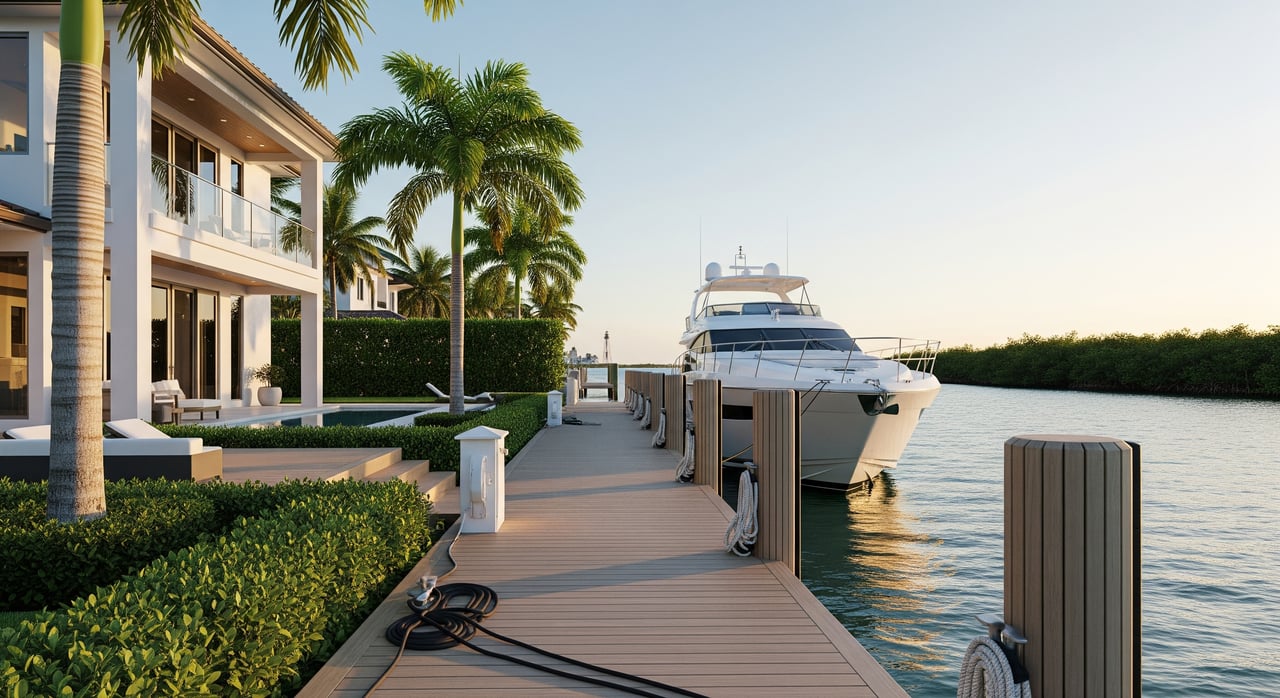
If you love the idea of stepping off your patio and idling to the sandbar or offshore in minutes… then you already know this:
In Jupiter, the neighborhood matters just as much as the house.
Because here’s the truth most listing photos won’t show you:
-
A stunning waterfront home might sit behind a fixed bridge your boat can’t clear.
-
A “deep water” canal might feel tight once the wind picks up.
-
A dock might look big enough — until you factor in beam, pilings, and fenders.
So let’s walk through how to evaluate Jupiter real estate through a true boater’s lens — the way I would if we were touring properties together.
1. Start With Your Boat — Not the House
Before we look at homes, we define your vessel profile:
-
LOA (Length Overall)
-
Beam (Width)
-
Draft
-
Air Draft (height from waterline to highest fixed point)
Air draft is usually the deal-breaker.
If your boat barely clears a bridge on paper, treat that as a no. Published bridge heights are based on tidal datum — and tides change daily.
Measure your boat in cruising configuration. Then build in a safety margin.
2. Bridge Clearances to the Inlet
Most Jupiter waterfront routes run through canals and the Intracoastal before reaching Jupiter Inlet.
If there’s a fixed bridge on your route, it must clear comfortably.
To verify:
-
Review NOAA nautical charts
-
Check the U.S. Coast Guard Local Notice to Mariners
-
Confirm the bridge type and tidal datum used
If clearance is tight:
-
Time passage with tides
-
Confirm Mean High Water reference
-
Call local bridge authorities if needed
When in doubt? We verify before you go under contract.
3. Canal Width & Turning Room
This is where lifestyle meets reality.
A narrow canal turns docking into a weekly stress test.
General comfort ranges:
-
40–50+ ft fairway for mid-size powerboats
-
Turning basin ideally 1.5–3x boat length
-
Side-tie often easier in tighter canals
When we preview homes, we look for:
-
Dead-end canals
-
Shoaling history
-
Prevailing wind direction
-
Dredging schedules
Some Jupiter neighborhoods feel effortless to dock in. Others… not so much.
4. Dock Type & Infrastructure
The dock isn’t a bonus feature — it’s core infrastructure.
Fixed vs Floating
-
Fixed docks = stable, higher elevation
-
Floating docks = easier boarding with tide changes
Slip Fit
-
Confirm usable length (not advertised length)
-
Check beam clearance
-
Account for fenders
Pilings & Hardware
-
Diameter & spacing
-
Structural condition
-
Cleat placement
Utilities
-
Shore power amperage
-
Water access
-
Safe walkway slope
And yes — always request:
-
Dock permits
-
Seawall permits
-
Maintenance records
Replacement may require county or state approvals.
5. HOA Rules, Slip Ownership & Permits
Not all Jupiter waterfront homes operate the same way.
You need clarity on:
-
Is the slip deeded or HOA-assigned?
-
Does it transfer at sale?
-
Are rentals allowed?
-
Maintenance restrictions?
-
Insurance minimums?
Confirm dock and seawall permits through:
-
Palm Beach County Building Division
-
Florida DEP Environmental Resource Permitting
-
South Florida Water Management District if water control impacts apply
Never assume permits are current.
6. Travel Time to Jupiter Inlet
This is part of the lifestyle.
To estimate:
Time (hours) = Nautical Miles ÷ Speed (knots)
Then adjust for:
-
No-wake zones
-
Weekend traffic
-
Bridge timing
-
Tides & current
Use NOAA tide predictions before committing to a route.
And honestly? Ask local captains. Real-world feedback matters.
7. Local Conditions You Need to Plan For
Jupiter Inlet is dynamic.
-
Strong tidal currents
-
Occasional shoaling
-
Seasonal channel changes
Check:
-
NOAA charts
-
USCG Notices
-
Dredging updates
Environmental protections here (seagrass, manatee zones) may influence dock modifications and fueling rules.
8. A Simple Property Scoring System
When touring homes, score each property 1–5 in these areas:
Vessel Fit (Mandatory)
Dock length, beam room, bridge clearance.
Access & Maneuverability (High)
Canal width, turning basin, wind exposure.
Dock Condition (High)
Structure, pilings, utilities.
Legal & Administrative (High)
Slip ownership clarity, permit status, HOA alignment.
Travel Time (Medium)
Realistic inlet access.
Services (Medium)
Fuel, haul-out, marine mechanics proximity.
Insurance & Costs (Medium)
HOA fees, seawall responsibility, required liability coverage.
If a home fails a must-have — we eliminate it.
Emotion doesn’t override boat math.
9. Finding Dock-Ready Listings in Jupiter
MLS filters to use:
-
“Private dock”
-
“Deep water”
-
“Boat lift”
-
“No fixed bridges”
Always request:
-
Dock dimensions
-
Piling specs
-
Permit copies
-
Photos from waterline
Inventory here moves quickly — especially homes with true no-fixed-bridge access.
The more precise your boat specs, the better your shortlist.
Why Jupiter?
Because Jupiter blends:
-
Quick Atlantic access
-
Intracoastal cruising
-
Sandbar culture
-
Strong waterfront demand
-
Long-term real estate resilience
And when you choose correctly, your dock becomes part of your daily rhythm — not a stress point.
FAQs
What is air draft and why does it matter?
Air draft is your boat’s height above the waterline. It determines whether you can clear fixed bridges on the way to Jupiter Inlet.
How do I verify real bridge clearance?
Compare your measured air draft with NOAA charted bridge clearance and check the U.S. Coast Guard Local Notice to Mariners for updates.
What canal width feels comfortable for a 35–45 ft boat?
Many boaters prefer 40–50+ ft fairways and a turning basin roughly 1.5–3 times boat length.
Do dock permits transfer when buying?
Not automatically. Always confirm permit status and transferability with Palm Beach County and Florida DEP before closing.
How do I estimate run time to Jupiter Inlet?
Divide nautical miles by cruising speed in knots, then adjust for no-wake zones, tides, and traffic.
If you’re serious about buying a waterfront home in Jupiter, share your boat specs first.
From there, we narrow neighborhoods that truly fit — so your first run to the inlet feels effortless.
